

Reaching the B1 level in French is a genuine turning point. It is the moment when you stop surviving conversations and start actually having them: talking about your plans, sharing opinions, handling unexpected situations. But the jump from A2 to B1 is not automatic, and many learners stall at the elementary level without understanding why. To help you cross that threshold, we have put together a 12-week study plan combining structured online courses with focused self-study time.
Is it really possible to go from A2 to B1 in three months? Yes, if you are consistent and strategic about it. The A2 level gives you the survival toolkit; B1 asks you to use it fluently and flexibly. That shift requires not just more vocabulary, but deeper confidence with tenses, clearer pronunciation, and the ability to handle topics you have not prepared for. For the best chance of success, we recommend taking online courses with a qualified teacher: at this stage, having someone correct your mistakes in real time makes a huge difference to how fast you progress.
If you have not yet reached A2, start with the basics before diving into this plan. If you are already comfortable at B1 and looking to go further, check out our B2 to C1 plan. Otherwise, keep reading! Here is a 12-week schedule combining two hours of weekly lessons with self-study sessions in between. Adapt it to your routine: consistency matters far more than perfection.
Weekly Schedule to Go From A2 to B1 in French
Weeks 1 to 4: Reinforce your foundations
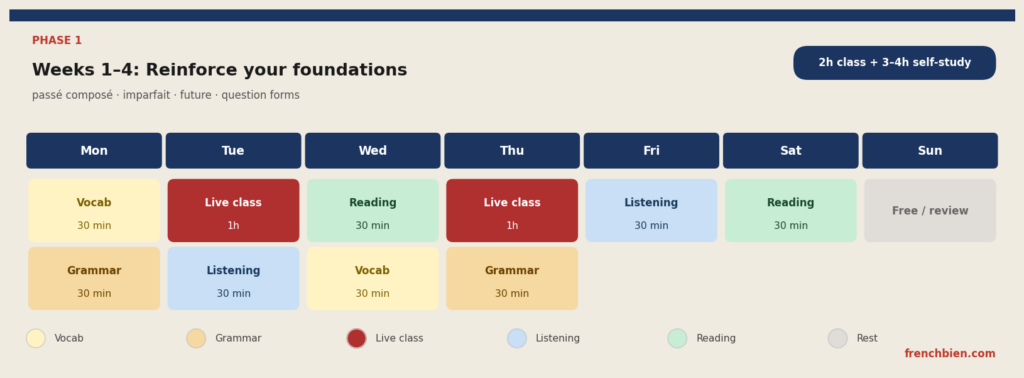
At A2, you already know the basics: you can introduce yourself, handle simple transactions, and follow slow, clear speech. But B1 demands something more: reliability. You need tenses to come naturally, not after a moment of internal translation. Before building new skills, the first month is about making sure your foundations are solid enough to carry the rest.
Online classes (2h per week):
Use your sessions to consolidate the core grammar that A2 learners often use inconsistently: the passé composé versus the imparfait, the immediate future (aller + infinitif), the simple future, and question forms. Ask your teacher to focus on the tenses you confuse most (not the ones you already use well). Two one-hour sessions per week work best, but Global Lingua also offers 30-minute sessions if your schedule is tight.
Self-study (3–4h per week):
- Grammar (30 min x 2): Work through exercises targeting the passé composé, imparfait, and future tenses. Resources like Grammaire progressive du français – niveau intermédiaire, the Bonjour de France website, or the Sapere AI platform are all good options.
- Vocabulary (30 min x 2): Learn 15–20 words per week, focusing on useful vocabulary for you and your professional field and grouped by theme (travel, health, work, emotions). Write them on post-its and stick them where you will see them: bathroom mirror, fridge, desk.
- Listening (30 min x 2): Watch videos designed for learners — YouTube channels for French learners or TV episodes with French subtitles. The goal at this stage is exposure to natural rhythm, not perfect comprehension.
- Reading (30 min x 2): Read simple texts: adapted short stories, easy news articles, or graded readers aimed at A2–B1 level. Focus on getting the gist rather than understanding every word.
Does four hours of self-study a week seem like a lot? Think of it this way: it is less than 35 minutes a day. Spread it across small daily sessions and it becomes manageable — and far more effective than cramming at weekends.
Weeks 5 to 8: Consolidation and active practice
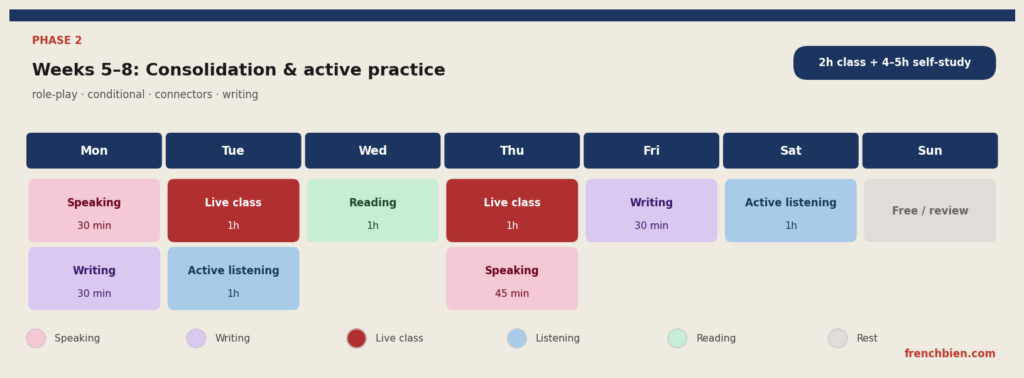
You have now refreshed your foundations. The next step is putting grammar into practice through real communication: the kind you cannot prepare word for word in advance. This is where B1 is truly built: in the unscripted moments.
Online classes (2h per week):
This is the time to shift your lessons toward conversation. Ask your teacher to set up role-play scenarios: buying a train ticket, explaining a problem at work, describing a film you have seen, giving directions. These everyday situations force you to combine vocabulary, tense choice, and spontaneity — exactly the skills B1 requires. This is also a good time to deepen your knowledge of the conditional (je voudrais, ce serait bien si…) and how to link ideas with connectors like pourtant, donc, en revanche, and par contre.
Self-study (4–5h per week):
It is time to raise the stakes slightly. Try to combine studying with daily life so it does not feel like extra work.
- Oral practice (30 min x 2): Record yourself answering open-ended questions. You can describe your weekend, give your opinion on a news story, talk about a plan you have. Listen back, spot the hesitations and grammar slips, and try again. It feels awkward at first, but it is one of the most effective solo speaking exercises you can do.
- Writing (30 min x 2): Write short texts: an email to a friend, a postcard, a brief description of your neighbourhood. Aim for accuracy rather than length. Consider keeping a short French journal to document your progress — it also becomes a useful record of how far you have come.
- Listening (1h): Listen to a French podcast adapted for learners or a simple French song, then note down any vocabulary or expressions you did not know. Active listening (with a pen in hand) is significantly more effective than background listening.
- Grammar and vocabulary (1h): Use an AI-powered learning platform like Sapere to practice vocabulary in context, or work through grammar exercises targeting the specific points your teacher has flagged.
Weeks 9 to 12: Objective B1
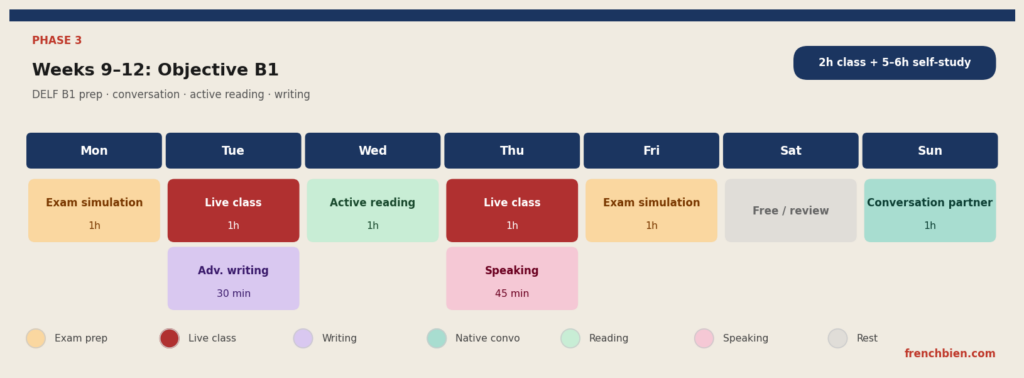
The home stretch! Now it is time to bring everything together and prove to yourself — and any examiner — that you can handle the B1 level. This final phase is about range: can you talk about unfamiliar topics? Can you understand a news story on the radio? Can you write a coherent, structured paragraph on something you care about?
Online classes (2h per week):
Use your sessions to simulate the kinds of tasks that appear in B1 exams like the DELF B1: sustained oral production on a general topic, listening comprehension with note-taking, and structured written responses. Ask your teacher to evaluate your performance honestly and identify the specific points (like register, fluency, grammar accuracy) where you still lose marks.
Self-study (5–6h per week):
Do not ease off now: this is where the final push pays off.
- Exam simulation (1h): Test yourself with official DELF B1 sample papers from France Éducation International or practice platforms like Test Lingua. Time yourself strictly — managing exam conditions is a skill in itself.
- Conversation with a language partner (1h): Use platforms like Italki or Tandem to find a French-speaking conversation partner. Unlike lessons, these conversations are genuinely unpredictable, which is exactly what B1 asks you to handle. Sapere also offers conversational agents.
- Active reading (1h): Step up to real content: short news articles from 20 Minutes or Le Monde Ado, accessible short stories, or excerpts from easy French novels. Write down new vocabulary in a notebook or create flashcards.
- Active listening (1h): Watch French films or series with subtitles — French subtitles if possible, rather than English. Shows like Dix pour cent, Fais pas ci fais pas ça, or Un village français are excellent at this level. Note useful phrases and expressions as you watch.
- Advanced writing (30 min x 2): Go beyond simple emails. Practice writing short opinion pieces (150 to 200 words) where you present a point of view and give two or three reasons to support it. This skill is directly tested in the DELF B1 written production section.
How to Go From A2 to B1 in 3 Months: 6 Tips for Effective Learning
Ready for your challenge? Here are some principles to keep in mind during those demanding weeks.
Regularity over intensity: Studying for 30 minutes every day beats three hours every Sunday. Consistent, frequent contact with the language is how new structures get wired into your brain — not marathon sessions you can barely sustain.
Mix your skills: It is tempting to lean on what you are already good at, like reading if you are bookish, listening if you love music. Resist the temptation. Progress at B1 requires all four skills to move together: reading, listening, speaking, and writing.
Immersion in small doses: You do not need to move to France to immerse yourself in French. Change your phone language, follow French-speaking accounts on social media, cook from French recipes on YouTube, listen to French radio on your commute. Every small daily contact adds up.
Honest feedback: It is very hard to learn a language in isolation, especially at the intermediate level where your errors become more subtle and harder to self-detect. A teacher, a conversation partner, or an AI platform that gives corrections in context can save you weeks of reinforcing the wrong habits.
Small goals, real rewards: Set concrete weekly targets (learn 20 new words, finish a grammar chapter, record three speaking samples) and celebrate when you hit them. A language-learning journey that feels rewarding is one you will actually stick to.
Link French to what you already love: The learners who progress fastest are not always the most talented — they are the most motivated. If you love cooking, follow French recipe channels. If you love sport, read French sports coverage. If you love music, dig into French lyrics. Connecting the language to your existing interests makes the hours fly.
Are you ready to go from A2 to B1 in French? It is an ambitious challenge, but with a structured plan, the right resources, and steady motivation, three months can carry you across the threshold to genuine independence in the language. Start today: your future B1 self will thank you.