

Reaching the C1 level in French is the moment when your speaking, listening, reading and writing finally feel fluent. The gap between you and a native speaker shrinks to a handful of subtleties. But it is also one of the hardest jumps on the CEFR scale: many B2 learners plateau for months without realising it. To help you go from B2 to C1 in French, we have put together a 12-week study plan combining structured online courses with focused self-study time.
Is it really possible to go from B2 to C1 in three months? Honestly, the jump is steeper than B1 to B2, and you will need both consistency and a willingness to push past your comfort zone. But with the right plan, dramatic progress is well within reach. For the best chance of success, we recommend taking online courses with a qualified teacher: at C1 level, the errors that hold you back are subtle, and a trained eye is invaluable to identify and correct them. Plus, it will help you focus on your oral expression, a skill that is often overlooked, and wrongly so.
If you are not quite at B2 yet, start with our A2 to B1 in 3 months plan first. Otherwise, keep reading – here is a 12-week schedule combining two hours of weekly lessons with self-study sessions in between. Adapt it to your routine: consistency matters far more than perfection.
Weekly Schedule to Go From B2 to C1 in French
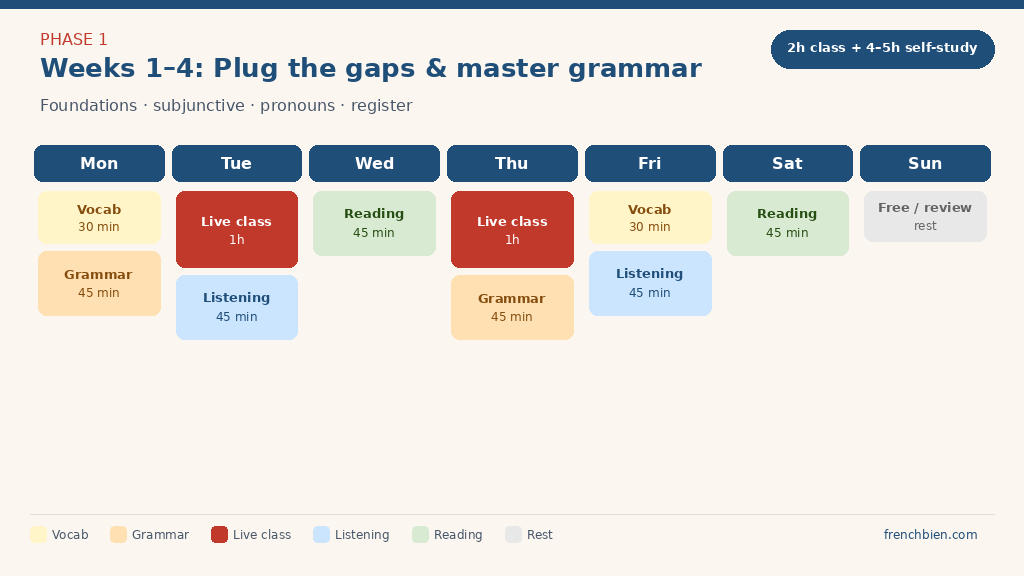
Weeks 1 to 4: Plug the gaps and master advanced grammar
At B2, you can already communicate confidently in most situations. But C1 demands something more: precision. Before sprinting toward fluency, you need to identify what is still wobbly. It might be the past subjunctive, double object pronouns, reported speech, or register shifts. This first month is about building rock-solid foundations for the rest of the plan.
Online classes (2h per week):
Use your sessions to drill the advanced grammar that many B2 learners avoid: the present and past subjunctive, the conditional past, reported speech, the passive voice, and the pronouns en, y and double pronouns. Ask your teacher to identify your specific weak points – at this level, generic exercises waste precious time.
Self-study (4-5h per week):
- Grammar (45 min x 2): Work through advanced grammar exercises. Solid resources include Grammaire progressive du français – niveau perfectionnement or online platforms like the AI-powered platform Sapere or Bonjour de France.
- Vocabulary (30 min x 2): Build synonym families (for example: dire / affirmer / prétendre / soutenir / déclarer) and aim for 25–30 new words per week, with a focus on register (formal, informal, slang).
- Listening (45 min x 2): Switch from learner-friendly content to native podcasts and news at natural speed. Try Transfert, Les Pieds sur terre, or our selection of French podcasts.
- Reading (45 min x 2): Read articles from Le Monde, Courrier international, or La Presse. Note new connectors (par ailleurs, en revanche, or, toutefois) and how they structure arguments – they are everywhere at C1.
Does working four or five extra hours a week seem like a lot to you? If you want to make quick (and lasting) progress, you have to put in the time. Remember: it is hard work, but it is only for a few months.
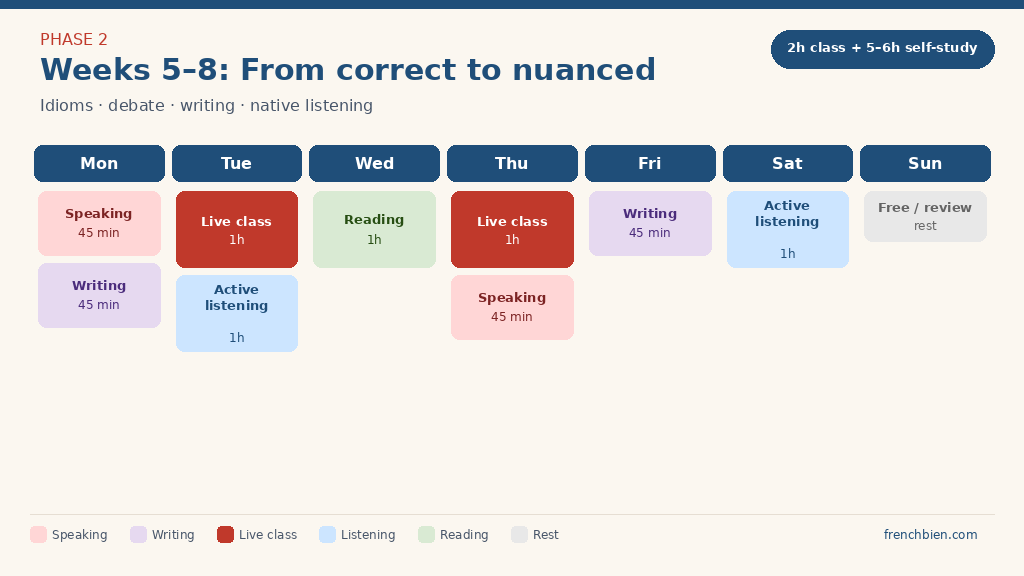
Weeks 5 to 8: From correct to nuanced
You have now patched the grammatical holes. The next challenge is moving from “correct” to “nuanced”: the hallmark of a C1 speaker. This phase is about idioms, register, and sustained speech: being able to argue, hesitate elegantly, change your mind, and disagree politely.
Online classes (2h per week):
Turn your sessions into structured debates. Ask your teacher to choose a current topic each week (politics, ecology, technology, culture) and defend a position. Have them correct not just grammar mistakes, but also register choices and idiomatic expressions. Role-playing professional scenarios (job interviews, formal emails, oral presentations) is extremely useful at this stage.
Self-study (5-6h per week):
- Oral expression (45 min x 2): Record yourself defending an opinion for five minutes on a complex topic. Listen back, identify hesitations and grammar slips, and re-record. This is one of the most underused techniques on the road to C1.
- Advanced writing (45 min x 2): Write structured opinion pieces of 250–300 words. Practise introducing a thesis, building arguments, addressing counterpoints, and concluding cleanly.
- Active listening (1h x 2): Watch French films and series without subtitles. Try Dix pour cent, Lupin, or films by François Ozon or Jacques Audiard. Note idiomatic expressions and informal speech patterns.
- Reading (1h): Read short stories, essays, or accessible French literature. Annie Ernaux, Anna Gavalda, or Romain Gary’s La Vie devant soi are excellent starting points.
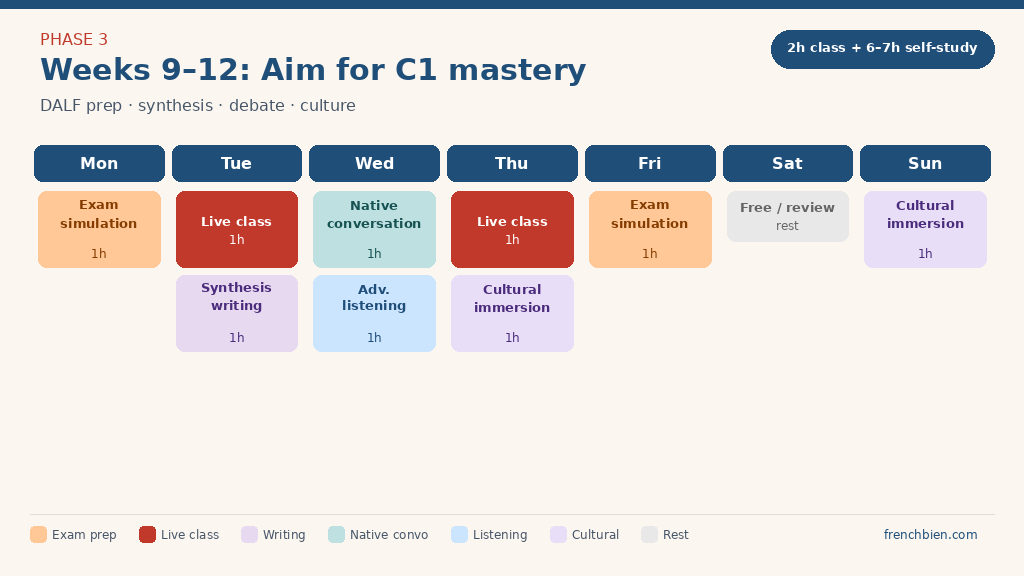
Weeks 9 to 12: Aim for C1 mastery
The home stretch! Now it is time to put it all together and simulate exam conditions. The C1 level is not just about understanding French – it is about handling abstract topics, synthesising information, and producing coherent, sophisticated discourse on demand.
Online classes (2h per week):
Use your sessions for full DALF C1 mock exams: oral synthesis exercises, listening comprehension on complex topics, and structured oral presentations. Ask your teacher to evaluate you against the official DALF C1 grading criteria so you know exactly where you stand.
Self-study (6-7h per week):
- Exam simulation (1h x 2): Tackle official DALF C1 sample papers from France Éducation International. Time yourself strictly – managing pressure is half the battle.
- Synthesis writing (1h): Synthesise two or three articles on the same topic into a single coherent essay. This is one of the trickiest C1 skills, and the most rewarded by examiners.
- Conversation with a native speaker (1h): Use platforms like Italki or Tandem to talk with a French native at least once a week. The unscripted nature of real conversations is irreplaceable.
- Advanced listening (1h): Listen to political debates, intellectual podcasts (France Culture, Les Chemins de la philosophie), or stand-up comedy. Comedy is a brilliant C1 stress test because you have to grasp wordplay, cultural references, and irony in real time.
- Cultural immersion (1h): Read Le Monde editorials or watch C dans l’air, 28 Minutes (Arte), or Quotidien. C1 is as much about cultural fluency as linguistic fluency.
How to Go From B2 to C1 in 3 Months: 6 Tips for Effective Learning
Ready for your challenge? Here are some tips to remember during those difficult weeks.
Quality over quantity: At B2, doing more was helpful. At C1, doing more carefully is what counts. Slow down, analyse, repeat, refine.
Active immersion: Passive listening is no longer enough. You must actively analyse: why did the speaker choose that idiom? What register is this article written in? Active engagement is what turns input into output.
Expert feedback: It is almost impossible to reach C1 alone. The errors holding you back are too subtle to spot yourself. A teacher, a conversation partner, or even an AI platform can make the difference between a B2+ plateau and a real C1 breakthrough.
Live in French: Set your phone, your social media, your podcasts and your Netflix recommendations to French. Read the news in French every morning. The goal is to make French your default mental language, not a separate compartment.
Develop opinions: A C1 speaker is not just someone who understands French – it is someone who thinks in French. Practise expressing nuanced opinions on complex subjects: ecology, politics, art, ethics. If you can debate, you are at C1.
Be patient with the plateau: The jump from B2 to C1 is famously frustrating because progress feels invisible for weeks before suddenly clicking. Trust the process, track your milestones, and celebrate the small wins along the way.

Are you ready to go from B2 to C1 in French? It is an ambitious challenge, but with a structured plan, the right resources, and steady motivation, three months can carry you across the threshold to truly advanced fluency. Start today: your future C1 self will thank you.