
The night before every game, Montreal’s CFL team trades the playbook for a French lesson. Here’s why that matters — and what every French learner can take from it.
Radio-Canada’s Patricia Ann Beaulieu recently went back to school with the Alouettes, and what she found is worth sharing with every French learner. (The quotes below come from her article, translated from French where needed.)
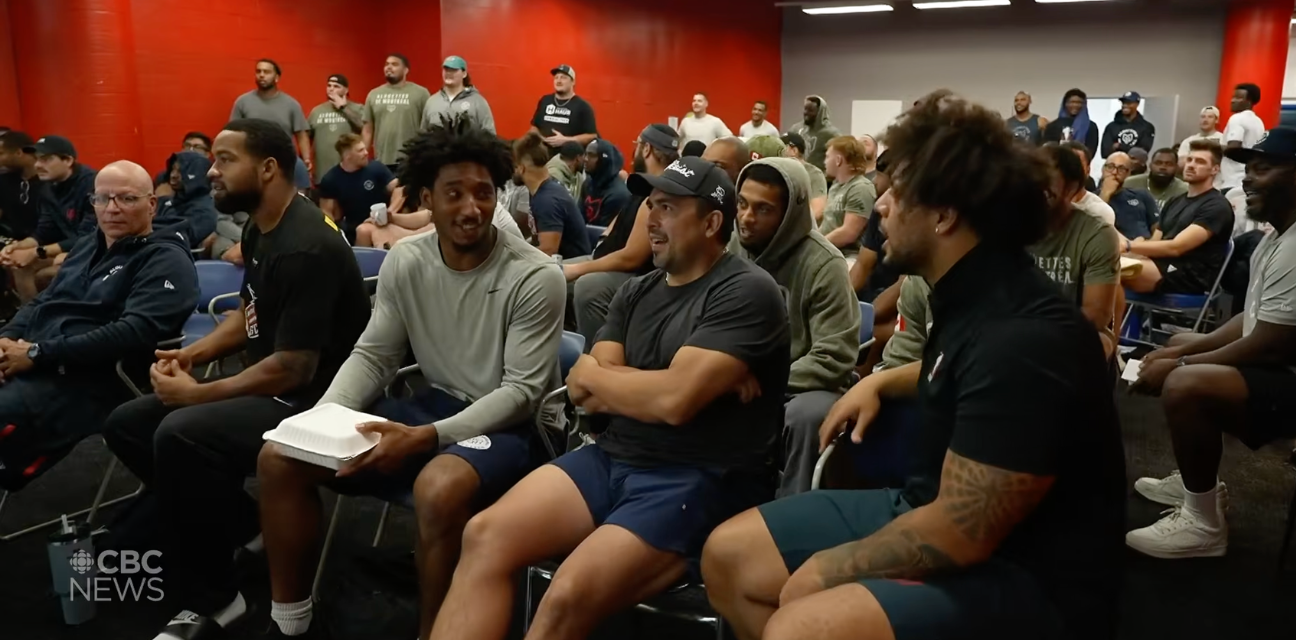
Picture about 60 professional football players, most of them from the United States or English Canada, sitting in a room and working on their Québécois pronunciation. It’s a little chaotic, but there’s also a lot of laughing.
French classes before every game
As Beaulieu reports, the Alouettes have been running short French workshops for several weeks now, held the day before each game. Each session lasts 20 to 30 minutes and covers:
- everyday Québécois expressions
- key words players can actually use
- pronunciation
The classes are organized by Mélodie Aumais, the team’s marketing projects coordinator, who swaps her coordinator hat for a teacher’s hat once a week. Her goal isn’t to make anyone bilingual overnight. It’s to get players comfortable enough to try French with teammates, fans and the media.
“French is so important. We’re a team from Quebec, for Quebec. We want our players to integrate as much as possible into the culture of our team and our province. So starting to speak French and having conversations with our fans is important to us.” — Mélodie Aumais, marketing projects coordinator, Montreal Alouettes (translated from French)
The push comes from the top. Head coach Jason Maas sees French as a way to better represent the province:
“Quebec is different from the rest of Canada and we wanted to reflect that. We believe it will help us get better and better represent our province, which we’re proud of.” — Jason Maas, head coach, Montreal Alouettes
Anglophone players showing up and trying
What stands out in Beaulieu’s report is how seriously the English-speaking players take this. Star receiver Tyson Philpot sees it as more than a communication tool. For him, it’s about respecting the culture of the city he plays for:
“Obviously, we have francophone players on our team who are very proud of it. We know it’s part of Montreal’s culture, and it’s a beautiful language.” — Tyson Philpot, receiver, Montreal Alouettes
Even the head coach is a student. Maas practises with an app on his phone, and when Radio-Canada told him his French sounded pretty good, he answered with a laugh:
“No, it’s not! Comme ci, comme ça. Trust me, it’s going, I’m trying. I hope it gets better as it goes.” — Jason Maas
That’s the attitude we love to see at Frenchbien: not perfect, but trying — and not afraid to be heard trying. The team’s social media even features short videos of anglophone players tackling Québécois expressions. They’re funny, but the message behind them is real.
And the effort is paying off. Linebacker and special-teams player Alexandre Gagné has noticed the progress:
“Just in their pronunciation, when we practise, things like that, it’s coming along well. […] Even if it’s for fun, they know that French is important.” — Alexandre Gagné, linebacker, Montreal Alouettes (translated from French)
Why learning with teammates works
The Alouettes didn’t hand each player an app and wish them luck. They learn together, in the same room, as a team. That changes everything.
A little friendly competition
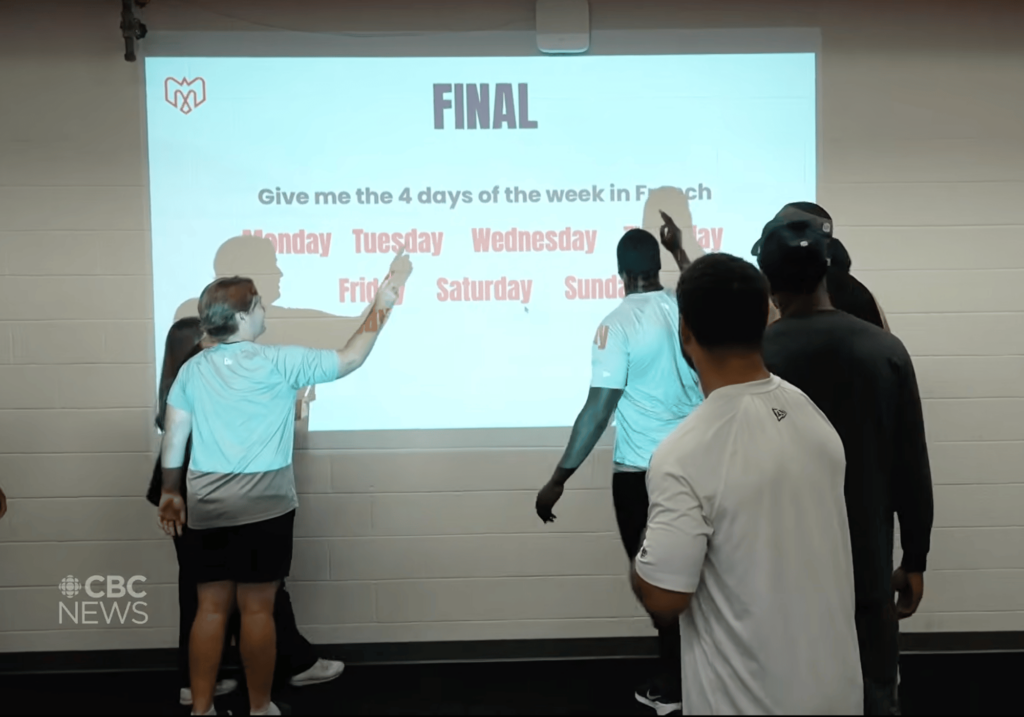
Pro athletes hate to lose — even at vocabulary games. Aumais built that into her lessons:
“It’s all done for fun, but also as a competition. The players are very invested. They really want to learn. […] We also have games in our lessons. It’s like a mini-competition for them.” — Mélodie Aumais (translated from French)
A quiz against the guy who sits next to you in the locker room is a lot more motivating than a streak counter. Competition turns practice into play, and play keeps people coming back.
Teammates who have your back
The other half of the story is support. The team’s francophone players aren’t just watching from the sidelines, they’re coaching their English-speaking teammates:
“Our francophone players are passionate about French. They really want our players to learn. They’ll push our anglophones to learn French.” — Mélodie Aumais (translated from French)
That’s the secret sauce. When you mispronounce a word in front of friends who want you to succeed, it’s not embarrassing: it’s part of the game. You get corrected, you laugh, you try again. And you’re more likely to use French outside class, because the people you practise with are the people you see every day.
Short study sessions and personalized content
In addition, what makes the Alouettes’ approach work is its format. The sessions are short, around 30 minutes, so they fit into a busy week without becoming a chore. And the content is built around what the players actually need: Québécois expressions they hear in the locker room, and simple ways to talk with fans and the media.
When every word you learn is one you can use the next day, motivation takes care of itself.

Your playbook: learn French like an Alouette
You don’t need a CFL contract to borrow their game plan:
- Keep it short and regular. 20 to 30 minutes, once or twice a week, adds up.
- Learn with people you already know. Colleagues, friends or family make it easier to show up and easier to make mistakes.
- Add a bit of competition. Games, quizzes, friendly bets… Whatever gets you playing to win.
- Find your francophone allies. Native speakers who cheer you on are the best coaches.
- Focus on words you’ll use. Everyday expressions beat perfect grammar when you’re starting out.
As Beaulieu puts it at the end of her piece, just like on the field, the learning happens step by step, as a team — one play and one word at a time.
Source: Patricia Ann Beaulieu, “Les Alouettes sur les bancs d’école chaque semaine pour apprendre le français”, Radio-Canada Sports. Quotes originally in French were translated by Frenchbien.